No. 72C, Mettu Street, Opposite to Mettu Street Bus Stand, Kanchipuram – 631501

×


×
Residential and Home Interior Designers in Chennai: Costs, Design Ideas and How to Choose the Right Designer
Hiring an interior designer is rarely just about choosing colours and furniture. It involves space planning, storage, electrical points, lighting, materials and budget, all coming together during execution.
For homeowners in Chennai, there is an added layer to consider. The city’s heat, humidity and seasonal moisture affect how materials perform over time, and most homes here are compact apartments where every square foot needs careful planning.
This guide covers what residential interior designers in Chennai actually do, what a home interior project typically costs, how the process works, and what to check before hiring someone to work on your home.
Why Hire a Professional Interior Designer in Chennai
Many homeowners see an interior designer as an added cost rather than a working partner. In practice, the value shows up in decisions you do not have to make alone and mistakes that get caught before they become expensive.
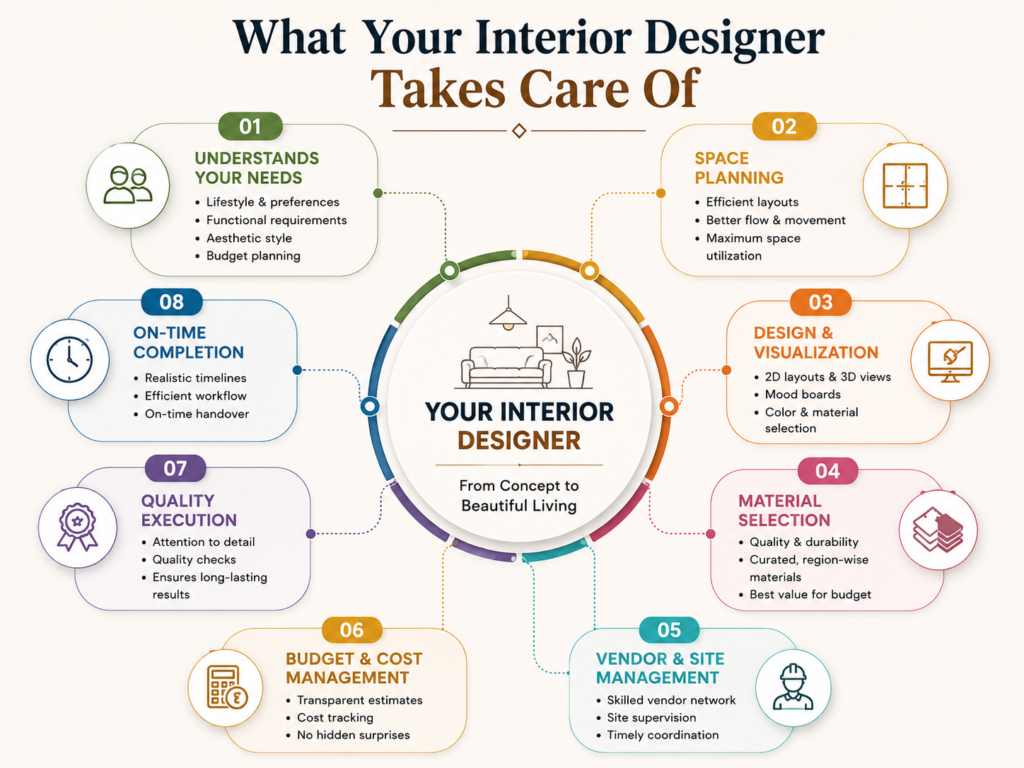
Here is what a designer actually takes off your plate:
- Space planning that fits how you will really use each room, worked out before anything is built. This matters because once carpentry and electrical work are finished, changing the layout means undoing completed work.
- Electrical coordination, so switch points, plug positions and lighting circuits are finalised with the electrician before furniture and false ceiling work begin.
- Material selection suited to Chennai’s climate, not just appearance. The wrong plywood, laminate or paint can start showing wear within a couple of years.
- Vendor coordination across carpenters, electricians, painters, and other vendors, each running on a different schedule.
- Budget tracking against what was actually planned, rather than decisions made room by room as costs creep up.
What Residential Interior Designers Actually Design
A full home interior project usually covers the same core areas, though how much work goes into each depends on the size of the home.
- Kitchen: Cabinet placement, storage and countertop material chosen around how you actually cook and store things, since a poorly planned kitchen is one of the hardest things to fix later.
- Living Room: Seating, lighting and furniture planned for daily family use as much as for guests, rather than furniture chosen only to look complete in a photo.
- Bedrooms: Wardrobe access, lighting and colour choices built around comfort and rest. Wardrobe placement is a detail homeowners often only notice is wrong after living with it for a while.
- Storage: Lofts and study units planned early rather than added later, since they depend on the same wall space as the rest of the room.
- False Ceiling and Lighting: Planned together, since a ceiling built without a lighting plan often leaves light points in the wrong places.
- Custom Furniture: Built to the exact size of a wall, since standard furniture rarely fits Chennai apartment layouts well.
Apartments, Independent Houses and Villas
The right design approach changes depending on the type of home.
A designer familiar with all three property types adjusts the process accordingly, since the planning logic for a compact 2 BHK apartment does not transfer directly to a villa.
Interior Design Costs in Chennai
Cost is one of the first questions homeowners ask, and it is a fair one, since interior work is a significant expense.
As a rough starting reference, smaller residential interior projects in Chennai can begin at around ₹3 lakh. However, there is no single price that applies to every home. The final cost depends on the size of the property, materials selected, amount of furniture, level of customization and the extent of electrical or civil work involved.
Before looking at specific project costs, it helps to understand the main factors that can move an interior budget up or down.
These factors explain why two homes of a similar size can still have very different interior budgets. A homeowner choosing standard finishes and essential furniture may spend considerably less than someone opting for premium materials, customized storage, extensive lighting and additional civil work.
To give you a more practical idea of what different types of interior projects can cost, the following figures can be used as indicative starting points.
These figures are useful for setting an initial budget, but they should not be treated as fixed quotations. The actual cost of an interior project can change once the designer understands the property, takes measurements and finalizes the materials and scope.
For example, a basic wardrobe may start at a relatively modest price, while a larger wardrobe with drawers, loft storage, premium hardware and specialized internal accessories can cost considerably more. The same principle applies to kitchens, TV units and complete home interiors.
Important: These are indicative starting prices for planning purposes and are not fixed quotations. The final cost depends on the size of the space, materials, hardware, design complexity, quantity of furniture, finish level, electrical requirements and any civil work involved. A project specific quotation is the best way to understand the actual investment required.
If you are comparing Home Interior Designers in Chennai, do not compare quotations based only on the final number. Check what each quotation includes, including materials, hardware, furniture, installation, electrical work, civil work and warranty. A lower quotation may not necessarily represent better value if important elements have been excluded.
The best approach is to compare quotations on a like for like basis and choose an interior design team that provides a clear scope of work and a detailed, room wise estimate for your specific home.
The Interior Design Process
- Consultation. Your lifestyle, budget, timeline and priorities are discussed before any design work begins.
- Site measurement. Actual room dimensions, natural light and existing electrical points are recorded on site.
- Concept and layout planning. Furniture placement, storage and movement paths are worked out based on how the home will actually be used.
- Visualisation. Seeing the design before work begins makes it far easier and cheaper to request changes than after carpentry has started.
- Material selection. Finishes, laminates, hardware and fixtures are finalised against the approved budget.
- Execution. Carpentry, electrical work, painting, flooring and installation proceed against a schedule, with site visits to check progress.
- Final inspection and handover. Every installation is checked for finish and function before the home is handed over.
Chennai’s Climate and Material Considerations
Chennai’s weather plays a bigger role in interior design decisions than most homeowners expect. Sustained heat, high humidity for much of the year and heavy monsoon moisture all affect how wood, laminate and paint perform over time.
- Plywood not suited to humid conditions can warp or develop joint issues faster than in drier climates.
- Laminates and paints behave differently under sustained heat and moisture, which affects finish and durability.
- Most 2 and 3 BHK homes in the city have limited storage built in by default, which is why storage planning is usually addressed early rather than left until the end.
A designer working regularly in Chennai homes tends to build these factors into material recommendations from the start, rather than treating them as an afterthought once a problem appears.
Current Interior Design Trends
- Minimalist Layouts: Fewer decorative elements and cleaner lines that make smaller rooms feel less cluttered.
- Built In Storage: Concealed cabinets and pull out units that use space more efficiently than freestanding furniture.
- Natural Materials: Wood tones and textured finishes chosen for durability rather than for following a trend cycle.
- Layered Lighting: Ambient, task and accent lighting combined instead of relying on a single central fixture.
- Flexible Furniture: Foldable and modular pieces for rooms that need to serve more than one purpose.
Common Mistakes Homeowners Should Avoid
- Designing purely for appearance. A room that looks impressive in photographs but is inconvenient to use daily becomes a source of frustration within months.
- Underestimating storage needs. This is one of the most common reasons homes start feeling cluttered within a year of moving in.
- Choosing cheaper materials to reduce upfront cost. This often results in higher repair costs later, particularly given Chennai’s climate.
- Skipping a proper lighting plan. Decorative fixtures alone rarely provide enough light for daily tasks.
- Changing decisions during execution. Once carpentry or electrical work has started, changes take longer and cost more than the same decision made during planning.
How to Choose the Right Interior Designer in Chennai
When comparing Residential Interior Designers in Chennai, look beyond portfolio images and compare their experience, process, material specifications, execution approach and warranty.
- Check the portfolio. Look for a varied range of completed projects, not just a few carefully chosen renders.
- Understand their process. A designer who clearly explains the stages from consultation to handover is usually more organised than one who gives vague timelines.
- Get it in writing. A room wise estimate, not a verbal figure, makes it far easier to compare quotations on a like for like basis.
- Ask about material grade. Plywood type and hardware quality affect both cost and durability more than most homeowners expect.
- Confirm the warranty. Ask exactly what is and is not covered before signing anything.
Why Consider Viruksham Interiors
With many interior design companies operating in Chennai, project experience and execution capacity are reasonable things to check before hiring anyone.
- 10+ years of experience in residential interior design
- 2,000+ projects completed across a wide range of home types
- 70+ projects currently ongoing
- 50+ team members supporting design and execution
- 10+ year warranty on completed work
Ten years of project history generally means familiarity with a wide range of homes, rather than a narrow set of repeated layouts. A high project count usually indicates that most common layout and storage problems have already been encountered and worked through before.
The number of ongoing projects and team size together give some indication of current execution capacity, and whether a company can manage multiple projects without stretching its team too thin. The warranty period is a useful signal that a company expects its work to hold up over time, though it is worth asking exactly what it covers before finalising a project.
None of this replaces the need to see actual project photos, ask direct questions, and get a clear, written estimate for your specific home.
Making the Right Decision for Your Home
Interior design is not a single decision but a series of smaller ones, from how a kitchen is laid out to which switch points go where. Together, these decisions determine how comfortable a home feels to live in every day, particularly in a climate like Chennai’s.
If you are planning a home interior project in Chennai, it is worth speaking with a few designers, comparing their process and estimates, and choosing based on how clearly they explain their approach to your specific home.
Viruksham Interiors offers consultations for homeowners planning a residential interior project in Chennai, with a project specific estimate based on your home rather than a generic figure.
Planning interiors for your Chennai home? Speak with the Viruksham Interiors team to discuss your requirements and get a project specific estimate based on your home’s layout, scope and material preferences.
×